
Axial Air Mover
High-velocity airflow that breaks up the saturated boundary layer at wet surfaces
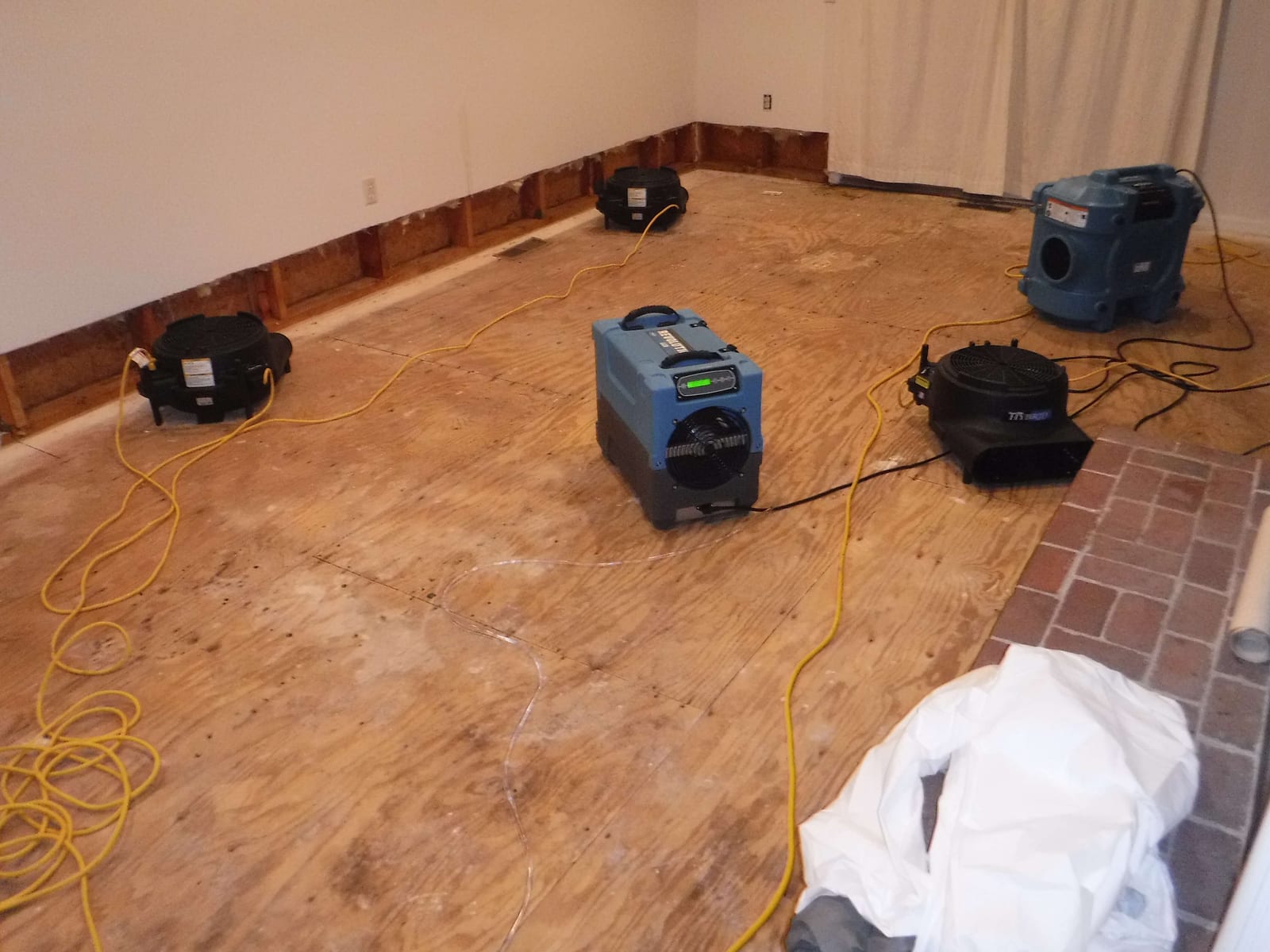
Air movers — sometimes called restoration fans or floor blowers — are the airflow half of restoration drying. They pair with LGR dehumidifiers: the dehumidifier removes moisture from the air, the air movers continuously refresh the moisture-laden boundary layer at the wet surface so evaporation can keep proceeding. Without air movers, evaporation stalls within minutes as the immediate boundary layer becomes saturated.
Two main types are used in restoration: axial fans (high airflow, lower static pressure — best for open-room drying), and centrifugal blowers (higher static pressure — best for forcing air through hose attachments into wall cavities, under floors, or through containment systems). Most residential drying uses axial units exclusively.
Sizing: industry rule is roughly 1 air mover per 50-70 sq ft of wet surface in standard residential drying. Colder or denser materials need more. On a typical 800 sq ft finished basement we'd deploy 10-15 air movers running 24/7 alongside 3-4 LGR dehumidifiers.
When we use it
- › Every residential and commercial water damage drying job
- › Whole-room drying of open floor areas
- › Sub-floor drying via hose attachment on centrifugal units
- › Wall-cavity drying via flood-cut and hose attachment
- › Hardwood floor specialty drying (with hardwood-specific mats)
How to read the output
Air movers don't have a quantitative readout — what matters is the drying log progress. Moisture meter readings at marked test points should drop predictably each day with air movers + dehumidifiers running together. If readings stall, the answer is usually more air movement (or more dehumidification, or both) — not just longer time.
Models we typically deploy
- › Phoenix Axial Air Mover (multiple sizes)
- › Dri-Eaz Velo / Sahara — workhorse axial units
- › Phoenix Focus / B-Air Vent — centrifugal models for cavity drying
- › Dri-Eaz Drizair / Replair — specialty hardwood floor drying mats with integrated airflow
Limitations
Air movers alone don't dry anything — they move air. Without a dehumidifier removing the moisture from that moving air, you're just circulating saturated air with no net drying effect. Air movers in cold environments can actually slow drying if they're pushing cool air past wet materials without dehumidification reducing the absolute humidity.
Axial Air Mover on real jobs
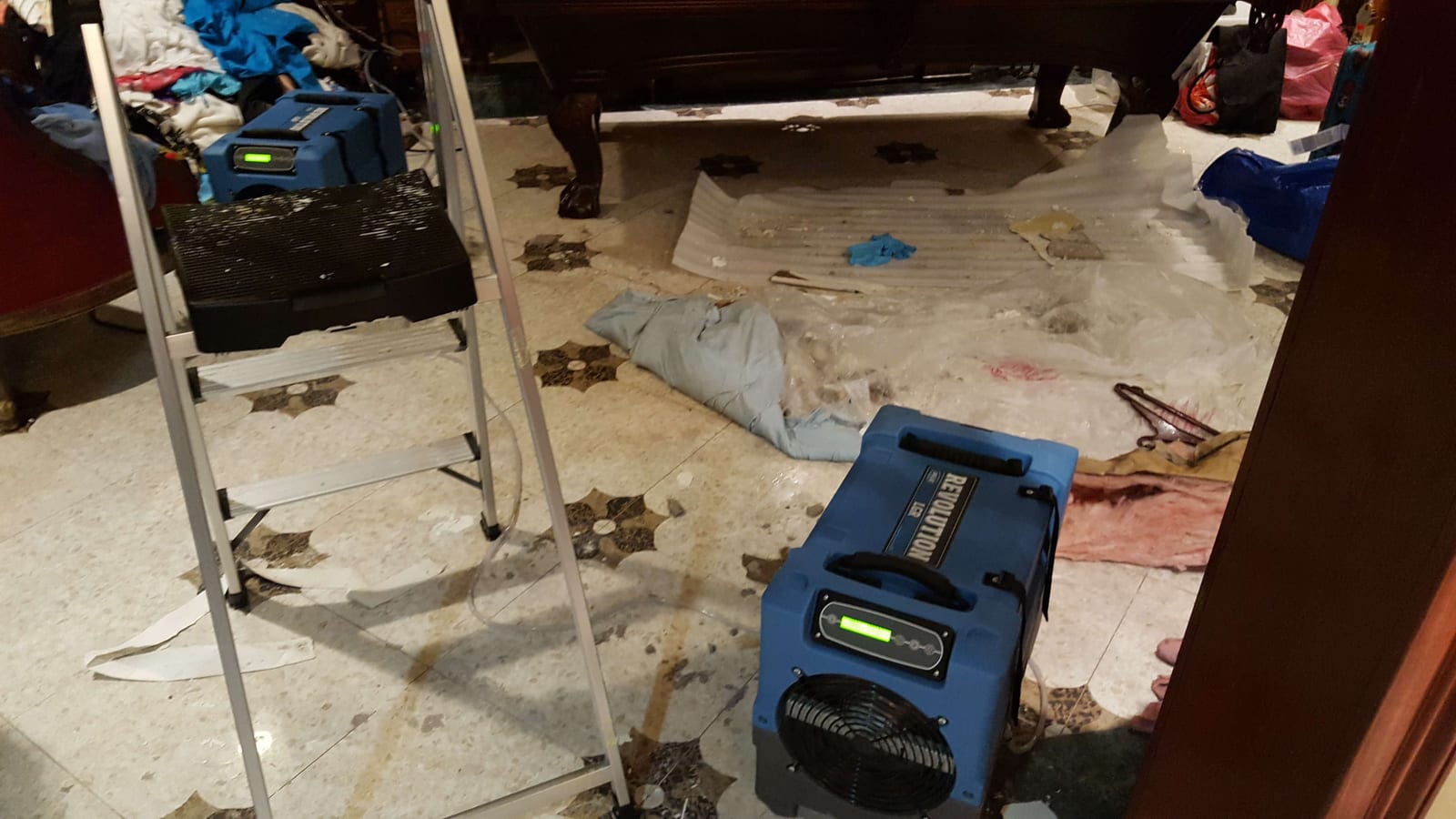
From 911 Storm restoration work in Fairfield County, CT and Westchester County, NY.
Common questions
Axial Air Mover FAQ
How many air movers does my drying job need?
Industry rule of thumb is 1 air mover per 50-70 sq ft of wet surface in standard residential drying — more for cold environments, dense materials, or Category 2/3 losses. On a typical 800 sq ft basement that's 10-15 air movers. The drying log tells you whether the count is right: if moisture readings drop daily, the airflow is adequate; if readings stall, more airflow is needed.
Are air movers loud?
Yes — running multiple air movers 24/7 in a home is loud. Decibel levels typically 60-70 dBA per unit. For occupied homes during drying we discuss noise mitigation options (containment routing, off-hours equipment cycling on lower-priority areas, temporary relocation in extreme cases). Most homeowners adapt within 1-2 days.
Can I turn the air movers off at night?
Not recommended. Continuous drying is significantly more efficient than start/stop cycles because the air movers + dehumidifiers maintain a low-humidity equilibrium that allows evaporation to keep proceeding. Cycling off allows the boundary layer to re-saturate, extending total drying time. The 24/7 noise is a temporary discomfort; extending drying by days adds real cost.
What's a centrifugal air mover and when is it used?
Centrifugal air movers (snail-shaped) produce higher static pressure than axial fans. Used when air needs to be forced through hose attachments — into wall cavities via flood-cut openings, under wood floor systems, through containment chamber walls. Less common than axial for open-room drying.
See this equipment on your loss
Free on-site assessment with FLIR thermal + moisture mapping + Xactimate scope. 60-minute response across Fairfield County, CT and Westchester County, NY.
Call (203) 604-2474Other restoration equipment
Damage Doesn't Wait — Neither Do We
60-minute response. Free estimate. We handle your insurance claim.
IICRC Certified • Licensed & Insured • All Major Insurance Carriers